
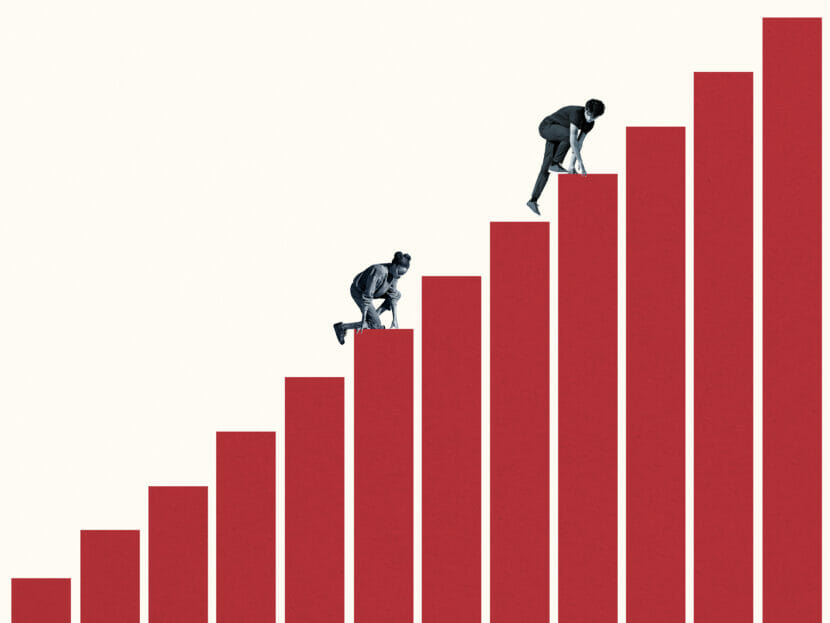
Tuesday is Equal Pay Day: March 14th represents how far into the year women have had to work to catch up to what their male colleagues earned the previous year.
In other words, women have to work nearly 15 months to earn what men make in 12 months.
82 cents on the dollar, and less for women of color
This is usually referred to as the gender pay gap. Here are the numbers:
– Women earn about 82 cents for every dollar a man earns
– For Black women, it’s about 65 cents
– For Latina women, it’s about 60 cents
Those gaps widen when comparing what women of color earn to the salaries of White men. These numbers have basically not budged in 20 years. That’s particularly strange because so many other things have changed:
– More women now graduate from college than men
– More women graduate from law school than men
– Medical school graduates are roughly half women
That should be seen as progress. So why hasn’t the pay gap improved too?
Francine Blau, an economist at Cornell who has been studying the gender pay gap for decades, calls this the $64,000 question. “Although if you adjust for inflation, it’s probably in the millions by now,” she jokes.
The childcare conundrum
Blau says one of the biggest factors here is childcare. Many women shy away from really demanding positions or work only part time because they need time and flexibility to care for their kids.
“Women will choose jobs or switch to occupations or companies that are more family friendly,” she explains. “But a lot of times those jobs will pay less.”
Other women leave the workforce entirely. For every woman at a senior management level who gets promoted, two women leave their jobs, most citing childcare as a major reason.
The “unexplained pay gap”
Even if you account for things like women taking more flexible jobs, working fewer hours, taking time off for childcare, etc., paychecks between the sexes still aren’t square. Blau and her research partner Lawrence Kahn controlled for “everything we could find reliable data on” and found that women still earn about 8% less than their male colleagues for the same job.
“It’s what we call the ‘unexplained pay gap,’” says Blau, then laughs. “Or, you could just call it discrimination.”
Mend the gap?
One way women could narrow the unexplained pay gap is, of course, to negotiate for higher salaries. But Blau points out that women are likely to experience backlash when they ask for more money. And it can be hard to know how much their male colleagues make and, therefore, what to ask for.
That is changing: a handful of states now require salary ranges be included in job postings.
Blau says that information can be a game changer at work for women and other marginalized groups: “They can get a real sense of, ‘Oh, this is the bottom of the range and this is the top of the range. What’s reasonable to ask for?’”
A pay raise, if the data is any indication.
Copyright 2023 NPR. To see more, visit https://www.npr.org.9(MDEwMjQ0ODM1MDEzNDk4MTEzNjU3NTRhYg004))
Transcript :
LEILA FADEL, HOST:
Today is Equal Pay Day. The date, March 14, is the day of the year when women’s pay finally catches up to what men made last year. In other words, women have to work an extra 10 weeks to be compensated equally. NPR’s Stacey Vanek Smith looks at why the pay gap persists.
STACEY VANEK SMITH, BYLINE: For a lot of people, there is a moment when they realize just how unfair pay can be. For Bridget Frey, that moment happened at her first job at a tech company. One of her fellow workers had gotten their hands on a list of everyone’s salaries and posted it online.
BRIDGET FREY: A site that was called F***ed Company.
VANEK SMITH: (Laughter).
FREY: I don’t know if I can say the actual name.
VANEK SMITH: Frey says what struck her more than anything was that what people got paid did not seem to have anything to do with their skills, their title or how hard they worked.
Did it seem random?
FREY: Yes.
VANEK SMITH: There was no obvious logic, just this big gray area.
FREY: There was a lot of gray. And then, gee, it seems like certain groups of people are more impacted by that ambiguity, by that gray space.
VANEK SMITH: Groups like women – the gender pay gap. So women earn about 82 cents for every dollar a man earns. For Black women, it’s about 65 cents. For Latina women, it’s about 60 cents. That pay gap has basically not budged in 20 years, but a lot of other things have. More women now graduate from college than men. More women graduate from law school. Roughly half of medical school graduates are women. So how has the pay gap not changed?
FRANCINE BLAU: Well, you know, that’s the – in my day, it was the $64,000 question.
VANEK SMITH: Francine Blau is an economist at Cornell. She has spent years studying the gender pay gap. She says one of the biggest factors is child care. Women will shy away from really demanding positions or will work just part-time in order to be able to care for their kids.
BLAU: Switching occupations or firms to those that are more family friendly but perhaps pay lower wages.
VANEK SMITH: And many will leave the workforce entirely. For every woman at a senior management level who gets promoted, two women leave, the majority citing child care. But even accounting for all of this and just about everything else, Blau found women still earn less, about 8% less for the same job.
BLAU: What we call an unexplained pay gap.
VANEK SMITH: One remedy here is negotiation. But Blau says women are very likely to experience backlash when they ask for more. And also, it can be hard to know how much to ask for. Part of that is changing. A handful of states now require salary ranges be included in job postings so people can more easily get information that in the past relied on moments like a renegade worker creating a tell-all website. Bridget Frey says she has carried that moment forward in her career.
FREY: Something that stayed with me when I eventually became a manager, just sort of this visceral understanding of how unfair these things can be and not wanting that to happen on my watch.
VANEK SMITH: Frey is now the chief technology officer at online real estate brokerage Redfin, and pushed the company to have transparent salary ranges for every position. She says the less gray area there is, the closer to equal pay can become.
Stacey Vanek Smith, NPR News. Transcript provided by NPR, Copyright NPR.