
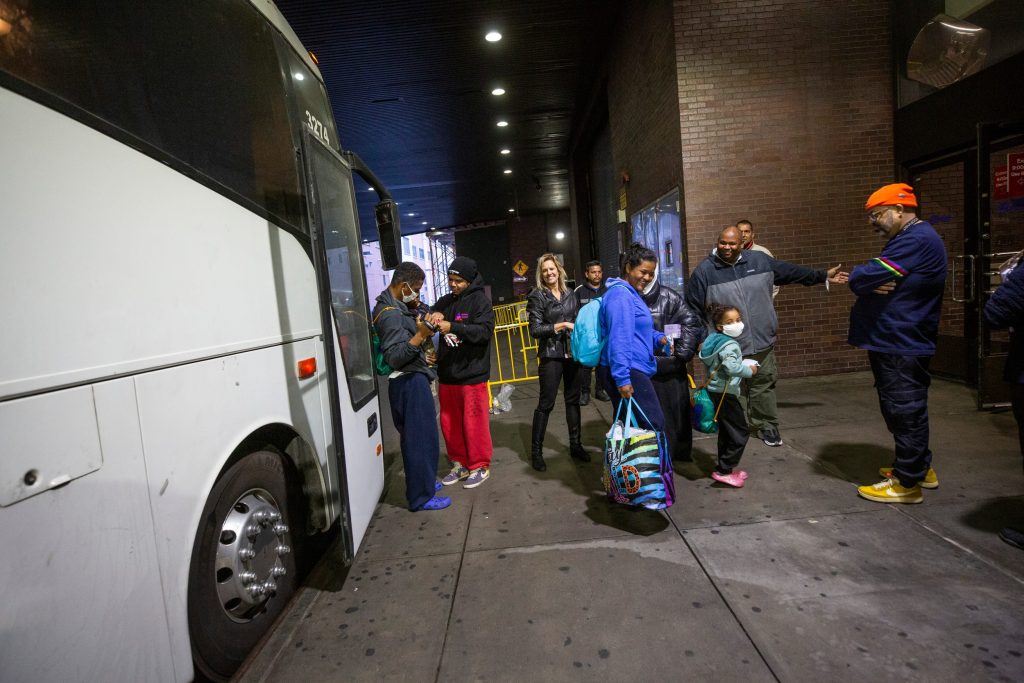
It was in many ways a cross-country bus ride. The children were hungry and tired, it was too cold, too hot, and each stop seemed too similar to the last.
The fluorescent halo illuminated gas pumps and brightly lit convenience shops in Texas, Tennessee, Virginia, Pennsylvania. It was a glowing beacon of light that reflected off the merchandise, which included overpriced goods and shared aisle space in a way not seen anywhere else.
Kristian Gonzalez Perez zoomed on his camcorder to hot dogs on a warmer, electronic tablets in a case and bananas in a basket each for $1.29
The Venezuelan 33-year-old, Katiuska Carolina Moreno, their two children and their wife were aboard one of the last migrant buses from El Paso.
They were among 10,713 asylum seekers that traveled the same route to New York via city-chartered buses. The El Paso Times and USA Today Network provided cameras to capture the family’s journey.
Gonzalez Perez and his family waited in line at El Paso’s Migrant Welcome Center for hours earlier, Oct. 19, just 35 days after leaving Venezuela. As the bus slowed down beside them, they smiled at the cellphone camera.
This family was among the last Venezuelan asylum seekers to receive entry and a ticket to their destination. Border Patrol had already begun returning Venezuelan migrants from Mexico. El Paso would close its welcome center soon and suspend the buses.
Leal Moreno (26 years old) had never seen Times Square in person. She imagined that if she were to ever find herself in Times Square, she might see King Kong. It was a joke, but it was her idea of ever seeing New York City.
Leal Moreno, her 5-year-old daughter Brittany, said, “We’re boarding a bus for New York,” to the camera. “Look, smile! “Are you happy?” Si asked her daughter. Their 3-year-old son Moises cried out in the arms of his father.
As everyone was getting on and off the bus, a city worker walked along the aisles and bid farewell.
Desde mi Corazon, she stated, “From the bottom my heart, I wish you all of the best: that you achieve your dreams and that you succeed in the United States.” God bless you, and best of luck!
The passengers sang gracias, and amen.
Under a cloudy sky, the bus pulled out of the parking lot at 3:00 p.m. Leal Moreno led a prayer and the children said goodbye to the city workers. bachata music was played. As seasoned travelers, she wore a cushion around the neck to ensure a smoother journey.
It was a turning moment in their lives, and for El Paso’s border during a humanitarian crisis.
They were separated by 2,200 miles between them and their destination.
Stories of migrants’ journeys through Americas, including tales from bandits and a massacre, are shared by migrants
American highways were framed by the blue curtains that were on the bus windows.
Gonzalez Perez focused his camera on children asleep in their parents’ laps on the flat plains blurring past. After hours, the migrants started trading stories.
Two women from Peru, one from Colombia and one from Nicaragua were among those who leaned in. Gonzalez Perez told stories from the road about escaping criminals and good Samaritans who helped them along their journey. He also recounted the narrow miss that his family made when they passed the Darien jungle. This is the notoriously dangerous area that divides Colombia and Panama. It was there where bandits had killed a family of migrants with their children two hours earlier.
A Colombian woman aged 30 who was traveling with her husband, daughter and son said that she flew directly to Mexico City.
“Oh you are so fortunate!” Gonzalez Perez said. “We had to go through the Darien.”
The woman stated, “We were held for eight days.”
He asked her, “In the nota?” She agreed. His family was also detained, he said.
Gonzalez Perez stated that they were going to release us immediately, but his children became sick and they kept us there for five days.
The Colombian woman shared how her family flew to Juarez with her. She wrapped a rosary around her neck and rubbed it. She said that she had family in Miami waiting for her; the bus from New York to El Paso would be cheaper.
Gonzalez Perez shared stories about buses that traveled north through Mexico and how masked men boarded them to rob people of 100 or 200 pesos.
He said, “Everyone has a unique experience.” “But, look at us. We did it.”
Gonzalez Perez and his family were the only ones in America. They tried to make it in New York.
Each stop was the exact same gas station in a different city: a Love’s Travel Center branded red, yellow, and orange.
Gonzalez Perez ran into the convenience store the second night looking for Maruchan instant soup. Many people spoke Spanish and filled the store with Spanish-speaking customers.
Gonzalez Perez moaned loudly, “Everything is expensive here.”
His wife grabbed a hotdog from the warmer.
He asked, jokingly, “None for you?”
He was jokingly teasing her. “You were going have soup, weren’t you?” They purchased a few hard-boiled eggs for their children. Real food was hard to come by, despite the abundance of candies and chips.
As they returned to the bus, she smiled at her husband with a tired smile. He called her “Caro”, shorthand. They weren’t sure where they were but knew they were at least halfway there.
They both knew that no matter how long the bus ride, or how hungry or exhausted they were, they had been given the chance of a lifetime.
Venezuelan asylum seekers are being targeted for arrest
It could have been different.
On the night of October 10, they crossed the Rio Grande and surrendered to Border Patrol at an El Paso mobile processing station. They can be seen smiling under Loop 375’s overpass in a cellphone video, Moises on his dad’s shoulders and Brittany on the back of her mother.
Leal Moreno tells the camera, ” Llegamos.” It was possible.
The United States responded to what was now the largest exodus of Western Hemisphere residents two days later. To quickly expel Venezuelan asylum-seekers to Mexico, the Biden administration reached a deal to work with Andres Manuel Lopez Obrador.
Although the family was already in Border Patrol custody at the time of the news, they were freed to the city’s welcoming center. The city chartered 294 buses to transport nearly 14,000 migrants between August and October at an $8.9 million federally reimbursable expense. Most of them wanted to travel to New York.
She said, “Years ago in Venezuela this is something which would have been impossible to me — impossible.” To travel to the U.S., you needed a visa and lots of money. We saw this opportunity as a chance for not only us, but also for our children.
Many other Venezuelan asylum seekers, as well as their families, were returned to Mexico. Many were staying in an encampment at the Juarez end of the Rio Grande. The United States was just outside reach for many of them.
“Imagine the feelings of those who are left behind. Gonzalez Perez said. “There are many people left in Mexico without food and with no idea of what the future holds. It is so unfair to be in this situation. It’s not something I want. Mexico is hard.”
“You are always welcome in New York”
Dawn broke at Jersey City’s Holland Tunnel, N.J. In rush hour traffic, the bus crawled to the east.
The Manhattan skyline rose in the light at the tunnel’s end.
Gonzalez Perez switched on his camcorder as the bus came to a halt at New York’s Port Authority bus station at 8 a.m. Oct. 21 after 40 hours of travel.
A man wearing a beanie, a sweatshirt and black pants boarded the plane and introduced himself to Power Malu. He was a son of Puerto Rican immigrants who is a volunteer at a non-profit organization there to welcome them.
Gonzalez Perez and his family considered El Paso their modern-day Ellis Island. They had reached the historic doorstep of the United States where the Statue of Liberty had been enshrined as the “Mother of Exiles” in poetry and millions had entered a new American lifestyle.
Malu in Spanish said, “If you hear people saying that you are coming to replace them or take their jobs,” “If their people were not born here 500 years ago, then they too are immigrants.” So, I want you to all know” and then emphasize every word that “you are welcome here in New York!”
Everyone cheered as they gathered their bags. Malu took off the paper bracelets that had been tagged as migrants and walked each passenger out of the bus.
He and other volunteers located them in a secure area of the terminal and registered their names. They also assigned the homeless shelter or rooms in the more than 50 city-chartered hotels to those who did not have a sponsor.
“Migrants,” however, are temporary migrants. Gonzalez Perez and Leal Mostno were different before they fled Venezuela, losing hope that their country would change.
Gonzalez Perez attended college in order to become an industrial inspector. This was 15 years ago when Venezuela was already experiencing an economic crisis. Before he and Leal moreno made the decision to go to Peru, he worked in Bolivar’s fast food industry. They were offered a job at a shrimping business, but economic problems and pandemics wiped out any gains and they returned home.
Leal Moreno was a hair stylist at her mother’s salon. She was a young mother. Brittany was born at 20 years old and Moises was born two years later. Her Venezuelan life photos on Facebook show her dressed up with straight black hair and winged eyeliner.
What could they do in the new city?
New York City’s future is filled with ‘purpose and goals’
Leal Moreno lay on the floor of the small room at The Row hotel’s 11th floor as a temporary shelter for migrants. Gonzalez Perez finished his first meal of chicken, rice and plantains in days, while Gonzalez Perez sipped juice box straws as he played.
He could only think of finding work.
He said, “When I get my first salary, then it will be real.” It’s amazing to see all the skyscrapers. When I get my first paycheck and can help my family, my children, my grandmother, my mother, aunt, cousins, brothers, and my father, that’s when it all feels worth it.
Leal Moreno pondered what the future might hold for her.
She said that she wanted to “leave the past behind” and “be a new Carolina with purpose, goals, and a vision.”
Her husband replied, “Amen,”
She said, nodding to her children “That’s what it’s like,” and added, “To grow and provide new opportunities.”
Their immediate responsibilities were very serious. They would have to check in with U.S. Immigration and Customs Enforcement. They would have to apply for work authorization and asylum, a difficult process that has no guarantees of success. They would need to enroll Brittany into kindergarten and find a place to live. The hotel-shelter was only available for three months.
They finally had their own room, which was something to be proud of.
The afternoon ended with father and son falling asleep together. Leal Moreno did not let them sleep for long.
New York City was right outside their windows. Times Square, the iconic cinematic landmark she had envisioned, was just a few steps away. She was eager to explore.
They wrapped their children in used clothes and took the elevator down. New Yorkers walked past the hotel’s glass doors as fast as they could. Car horns were blaring and street vendors sold food and quick COVID-19 testing — all this happened in the space of one city block.
They continued east on 45th Street, passing theaters, restaurants, and weaving through the crowds to reach the intersection where Broadway crosses 7th Avenue.
Times Square sparkled like a fairy tale. A man in a huge King Kong costume waved.
Last bus out: How one family's trip on a migrant bus delivered a dream via @USATODAY https://t.co/me238JutfV pic.twitter.com/fWICEtWYVE
— Jeffrey Levin 🇺🇦 (@jilevin) November 27, 2022