
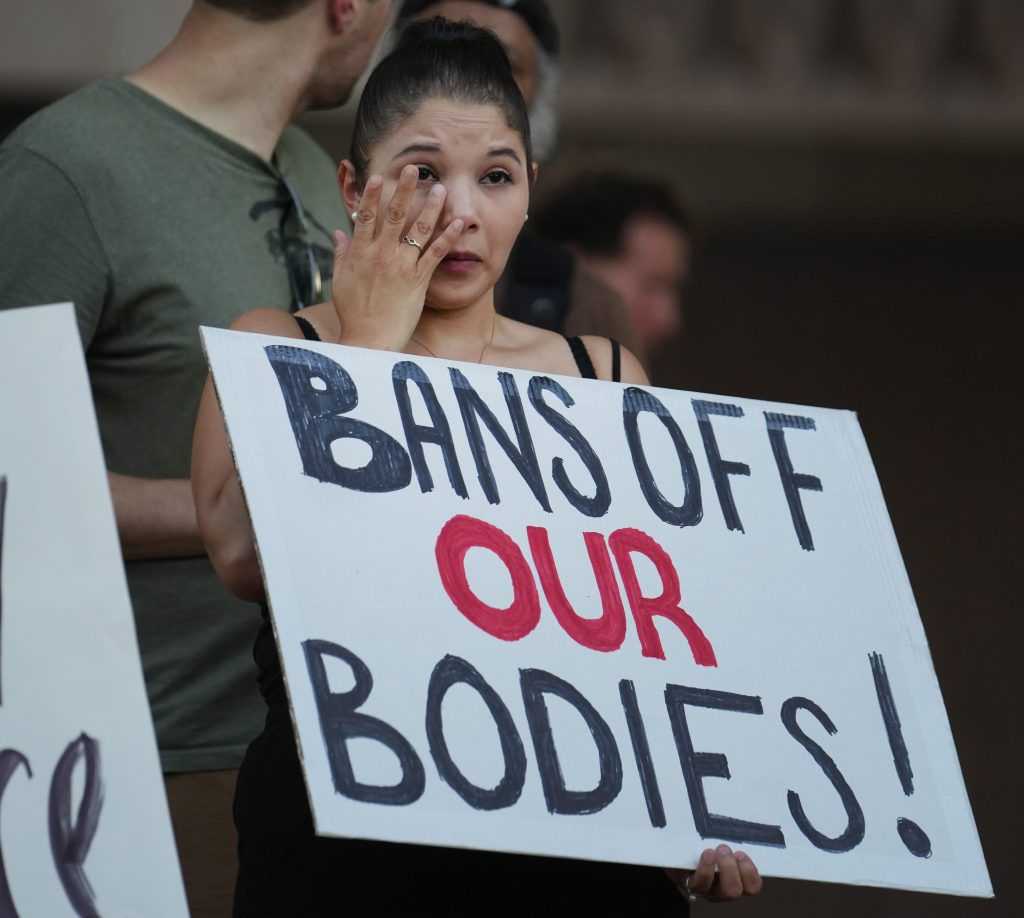
Arizona’s 1864 anti-abortion law to be argued before state appeals court https://t.co/CZVmxgcQ3F
— azcentral (@azcentral) November 30, 2022
The Arizona Court of Appeals will hear arguments Wednesday on the legal status of a Civil War-era law that requires abortion providers to serve time in prison.
Tucson’s 2 p.m. hearing is unlikely to result in a decision for at least several days.
e The law was signed by Gov. Doug Ducey signed this law in January. It bans abortions after 15-weeks gestation.
After Roe v. Wade was overturned by the U.S. Supreme Court in June, Arizona’s abortion facilities were temporarily closed. Even though the facility were allowed to reopen after the agreement with the state, providers and abortion rights activists remain concerned that the pre-statehood law could still be revived.
The law won’t be around much beyond Jan. 2, when Kris Mayes (Democratic) will take office. Mayes pledged not to enforce the old law, and indicated Wednesday that the state would cease its support for the “draconian” and unconstitutional law.
She told The Arizona Republic, “I will withhold the attorney general’s support for this law when I take over.”
The results of her race against Republican Abe Hamadeh were close enough that an automatic recount will be conducted after Dec. 5’s expected state certification.
Brnovich, a Republican, lost his bid to U.S. Senate to Blake Masters during the August primary election. He tried to make pre-statehood law enforceable after the U.S. Supreme Court overturned Roe v. Wade.
The Arizona Territory had a law, similar to all other states of the mid-19th-century, that prohibited abortions. It was drafted by Arizona’s first territorial Legislature in 1864 and imposes two to five years imprisonment for anyone who helps to give an abortion that is not necessary to save a mother’s life. The companion law, which required a woman to spend a year in prison if she had an abortion, was only repealed last year.
The prohibition on abortion was enforced in Arizona from 1973 to 1973, even though other states adopted more liberal policies. However, the Roe v. Wade decision in that year resulted a Pima County Superior Court injunction that placed the law on ice and put it on hold for 49 years.
Brnovich, who declared that the 1864 law is now valid after the U.S. Supreme Court decision, went to Tucson to lift the injunction. Planned Parenthood Arizona sought to maintain the injunction, arguing that Arizona state laws that regulate abortion must be “harmonized”. Planned Parenthood believes that a ruling that allows for the law to apply only to abortions performed by non-physicians is the best way to accomplish this.
According to Mayes’ campaign website, she would prefer lower limits.
Her site states that she is not going to prosecute physicians, nurses, midwives and pharmacists as a matter of law for providing or receiving reproductive services for women.
In her victory speech, Katie Hobbs, the Governor-elect, stated that she would do everything possible to repeal the 1864 abortion ban, which puts women’s lives in danger.