
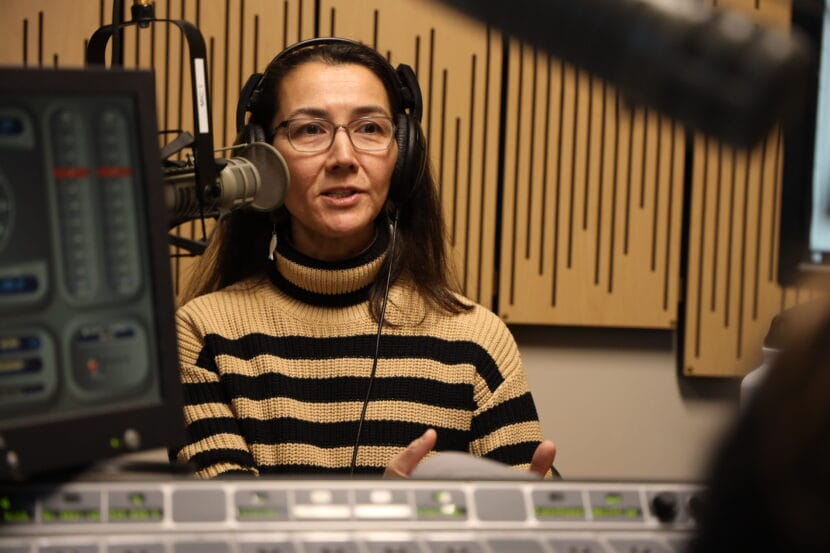
Alaska’s sole U.S. representative, Mary Peltola, visited Juneau over the weekend as part of a series of meet-and-greets she hosted across the state to kick off her reelection campaign.
Peltola, a Democrat, spoke with KTOO about her first term, why she thinks FEMA needs an overhaul, and more.
Listen:
This interview has been edited for length and clarity.
Mary Peltola: One of the things I’m very proud of is the work that my office has done in really leading the charge to convince the FTC not to approve the mega merger between Albertsons and Kroger. This really will affect every Alaskan household. Even if you’re in the bush, this will affect you. …
And of course, working on Willow. Willow is something that our leaders have been working on in Alaska for over a decade. And I am proud of the fact that I helped bring it across the finish line. I was the one who worked with the leadership in my caucus, to really insist that Joe Biden meet with us. That was not a sure thing. And it was really a coup that we were able to get a meeting with him and John Podesta and two of his other staff. And the senators and I made very compelling cases. And I do feel like I singularly did push that forward. …
One other thing I’m really proud of is the executive order that came out a few weeks ago, banning illegal Russian trawling, where they’re poaching our salmon, and marketing them through China using slave labor, Uyghur labor, driving down our prices. And that will affect fishermen in Southeast tremendously. If we can get those fish prices back up where they need to be, we can keep fishing. We can have fishing families that can continue to fish and make a profit.
Clarise Larson: The Alaska House Judiciary Committee advanced a bill earlier this month that would repeal ranked choice voting and open primaries. There’s also a group hoping to put the repeal question on the 2024 ballot. How has ranked choice voting shaped your campaigns, and what are your thoughts on these repeal attempts?
Mary Peltola: You know, a lot of people projected onto me that I was polite and didn’t slam other people because of ranked choice voting. That is like muscle memory for me. The 10 years that I worked in the legislature, that was a real take-home lesson that I learned, that you need to have 59 best friends if you want to get anything done. And I really have that just built into my habits, so that was natural. And it worked well for ranked choice voting. And I think that Americans and Alaskans want more civility and more middle-road candidates. It’s really interesting to me to hear very, very conservative people blasting ranked choice voting, because with ranked choice voting, we also elected the most conservative governor in the United States, Mike Dunleavy. … I do hope that other states look at this and see the success that it has brought, and it is not a complicated system. It’s very, very simple. And I’m very optimistic that ranked choice voting can help bring more middle of the road candidates forward who will put their names forward and work in a more collaborative way.
Clarise Larson: In Southeast and across Alaska, we’re seeing an increasing number of disasters that could be made more common or severe by climate change. What role can you play in helping Alaskans better prepare for that future?
Mary Peltola: FEMA needs a systemic overhaul. They were designed to accommodate six natural disasters a year. I believe last year, we had about 28. The size and scope of our natural disasters have compounded so much, and FEMA hasn’t really kept up with that in terms of their systems. So that is something that long-term needs to be addressed, and I’ll be happy to work on. …
We have seen in Southeast Alaska three very concerning mudslides, one in Haines, one in Sitka, and one in Wrangell. I was able to go to Wrangell and see firsthand the impact of the slide, talk to one of the victims, an amazing woman who survived the slide. I was able to talk with folks from the municipality and people who are there rescuing that night. And one of the things that we need to be working on in Alaska is really partnering with universities to get things like soil stability samples, taking a much closer look at areas that are of concern in Wrangell. The folks there on the ground said that there were multiple other sites that they would have guessed would have had a mudslide before the site that had it. So even for the folks who’ve lived there all their lives or have families who’ve lived there their whole lives, it’s really hard to tell where these mudslides might happen. And it’s really important as Alaskans for us to start getting a better ability to predict where these are and get out of harm’s way before a disaster happens.
Clarise Larson: To a lot of Americans, Congress seems pretty dysfunctional, with very little getting passed. And it seems like national politics are about as far as they could get from the kinds of bipartisan models we’ve seen in Alaska politics. Do you have any hopes left for a more productive Congress or thoughts on how that could come about?
Mary Peltola: I’m always hopeful. And I do believe that Alaska has so much to teach the rest of the nation in terms of working collaboratively and working across party lines and setting partisanship to the side to solve our problems. Nowhere else in America are you going to see a tripartisan House Minority and a tripartisan House majority, and I think that that is so reflective of Alaska.
