
The Juneau Assembly has asked city staff to move forward with a Telephone Hill redevelopment plan that would demolish the neighborhood’s historic homes and add more than 100 new housing units.
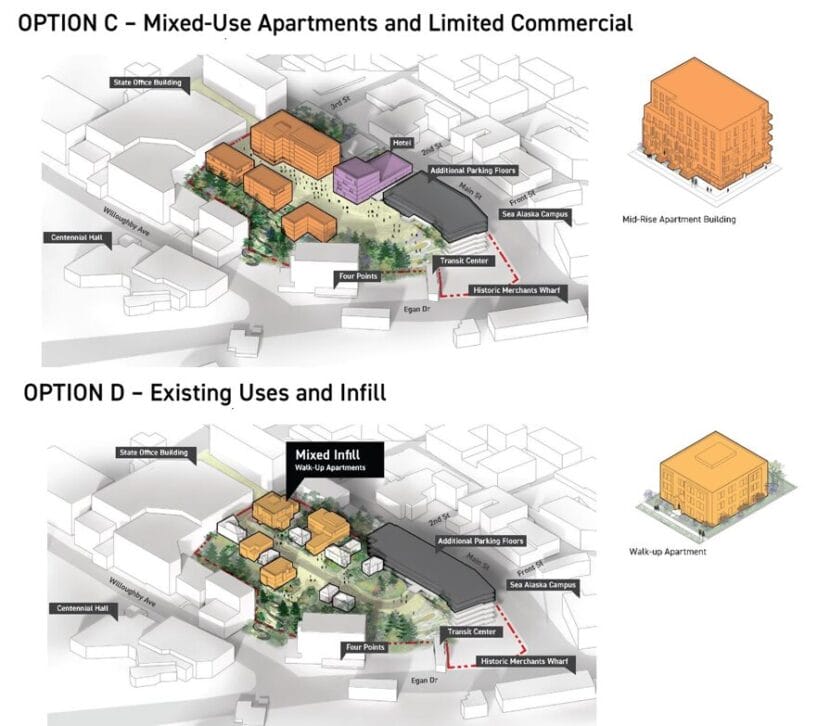
Designers shared four redevelopment models with Juneau residents in the fall. Option C added the most new housing — 100 to 200 apartments in mid-rise buildings. Option D was the only plan that preserved some of the existing houses while adding apartments among them.
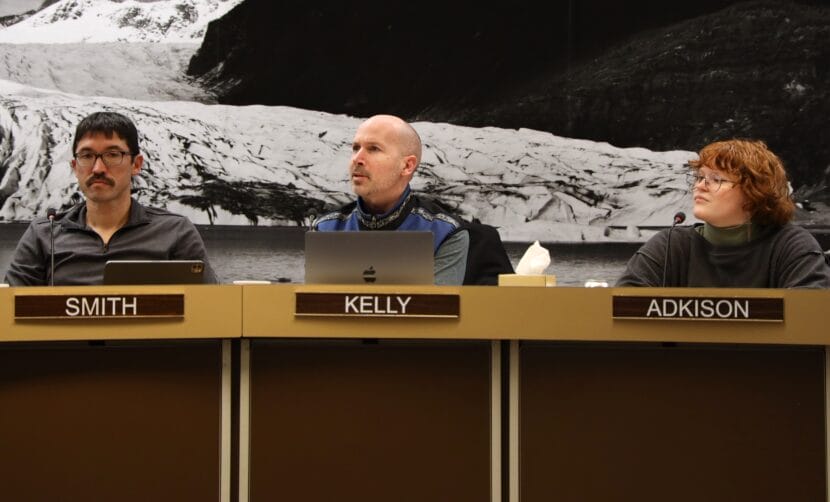
In an online survey, Juneau residents gave Option C just 13 more votes than D. But at an Assembly Committee of the Whole meeting Monday night, member Christine Woll said their decision was a response to Juneau’s housing crisis, not the survey.
“Option C barely quote-unquote won the survey,” she said. “I think that’s a useful piece of information, but I think our decision should be based on what we think is best for the community based on what we know.”
Assembly member Paul Kelly objected, saying he didn’t want to make Telephone Hill’s remaining tenants leave their homes.
“The level of housing people are asking for, I think we can achieve that and allow people who are living in the area to remain in their homes if we proceed with, instead, Option D,” he said.
But Mayor Beth Weldon said tenants may have had to leave even if the city left the houses standing.
“We have to remember that if we leave the houses there, the people that are in them currently may not stay in them because they’ll go up to fair market value,” she said. “And after my tour there — there’s a house there that has some land. It’s a big house with a view. That house is going to go for $900,000.”
Assembly member Wade Bryson said they had a responsibility to serve all of Juneau’s residents.
“I would hate for this Assembly to take an action that would stop economic growth for a small group of individuals, a small group of Juneauites,” he said. “That doesn’t seem like the common good or good for the community.”
The Assembly voted to direct staff to refine Option C, with Kelly voting no.
The Assembly also agreed that the historic review process had been sufficient, and that a more extensive review wasn’t necessary. Kelly cast the only no vote.
Architects had reported on the historic significance of Telephone Hill and its houses, most of which were built in the early 1900s. The state had owned the buildings from 1984 until last March, when it transferred ownership of the land to the City and Borough of Juneau.
An assessment of the buildings’ condition found water damage, roof leaks and rotten window sills and door frames in many of the houses. In the assessment, engineers wrote that it is “likely not economically feasible for CBJ to own or rent” the houses.
