
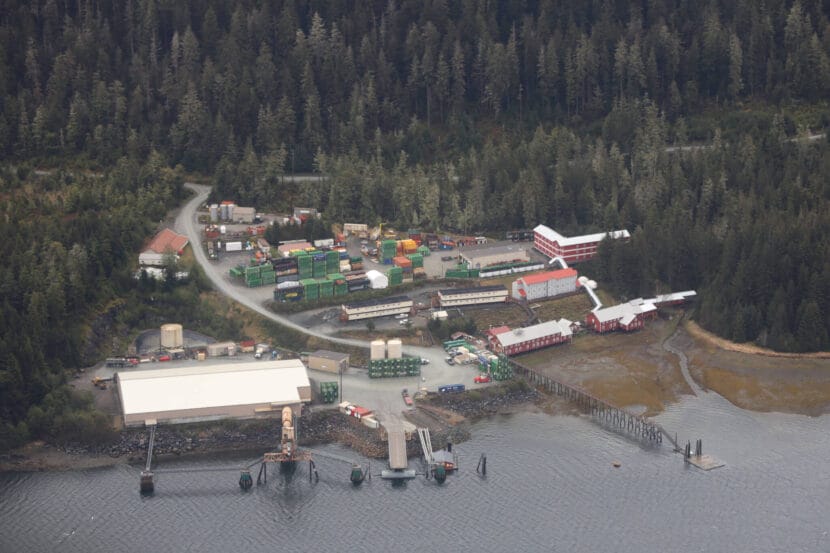
The U.S. Forest Service will issue a final proposal on Friday to allow Hecla Greens Creek Mine to expand their waste storage facility and continue operations for 12 to 18 more years.
Greens Creek is the nation’s largest silver producer and one of Juneau’s largest employers, with about 500 employees. The mine’s existing tailings facility on Admiralty Island stores ground rock and other waste leftover from the mining of silver, gold, lead and zinc. But that facility could run out of space as soon as next year.
If approved, the Forest Service’s new proposal would allow an additional 5 million cubic yards of waste storage — the equivalent of about 1,500 Olympic-sized swimming pools — along with the construction of a new road at the mine.
The proposed expansion, which will develop an additional 2.3 acres of land, is the most conservative alternative that the Forest Service considered. Two other proposals would have disturbed even more land, but extended the life of the mine by up to 28 years or 40 years.
This is the mine’s third expansion of its waste storage facility since it opened in 1989.
Because the mine operates within Admiralty Island National Monument, it must go through a strict environmental review process. The Forest Service’s proposal is accompanied by a supplemental environmental impact statement, which attempts to address some of the public feedback that has been collected since Greens Creek proposed the latest expansion nearly four years ago.
One of the primary concerns from environmentalists this time around focused on contamination linked to “fugitive dust,” or fine particles of ground rock laced with toxic metals like lead. They called for more measures to prevent that dust from blowing out of the tailings facility and into the environment.
Forest service geologist and project manager Matthew Reece says the agency has collaborated with the mine on a fugitive dust mitigation and monitoring plan that attempts to address public concern.
“We heard pretty loud and clear from the public during that process that they would like to see that plan,” Reece said. “Apart from that there were a lot of requests about additional biological monitoring and some additional water quality monitoring. So we’ve included a number of additional mitigations.”
The project will be constructed in two phases to allow for the additional monitoring. After phase one is completed, nearby creeks and lichen will be tested for fugitive dust contamination before the second phase of construction proceeds.
And additional water quality and biomonitoring sites will be added to keep track of potential fugitive dust contamination after the expansion project is complete.
This summer, the mine was fined $143,000 for violations of hazardous waste management protocols from 2019. Some of those violations had to do with lead contamination, when lead dust seeped out of a poorly sealed storage building and lead contaminated mining tools were disposed of in the tailings facility.
If the expansion of the waste facility moves forward, the mine will also have to hire an independent review board of engineers to oversee its design, construction and operation.
But Reece said the proposal is not yet final. Its release marks the start of a 45 day-comment period, in which individuals or organizations that have previously commented on the project can submit their objections by mail, fax or electronically before March 19.