
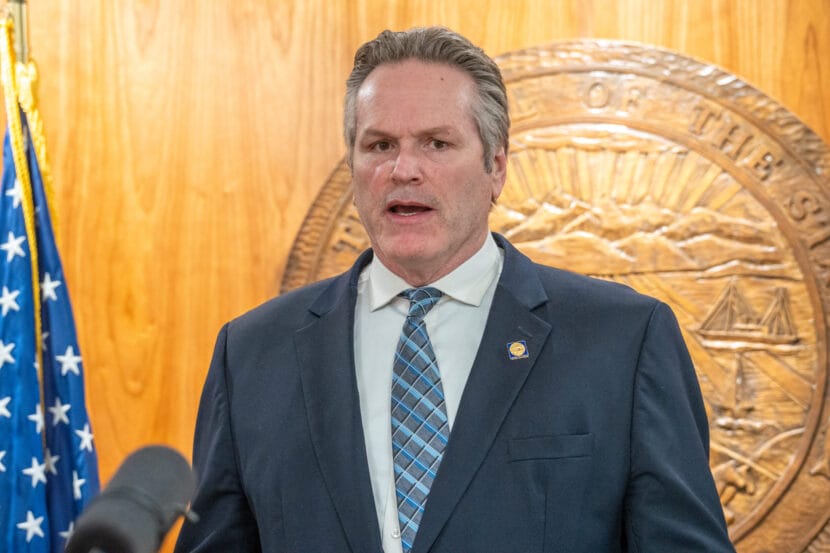
Gov. Mike Dunleavy is demanding the Legislature quickly pass additional legislation addressing his priorities before he will sign a bipartisan education bill that passed the House and Senate by overwhelming margins earlier this month. Otherwise, Dunleavy is threatening to veto the bill.
The education bill, Senate Bill 140, is a top priority for leaders of the state House and Senate and would provide the first substantial boost to state funding for public schools since 2016. But Dunleavy said at a news conference Tuesday that the bill needs work.
“It’s a three-legged horse, meaning it’s not going to run very far,” he said. “But we can fix that. We have 15 days before it becomes law or before I veto. And I made it clear that if there are not certain elements in that bill … I won’t sign it into law. I’ll veto it.”
Dunleavy must act on the bill by March 14, or it becomes law without his signature. He said it’s clear that state education funding needs a boost, but he says the bill fails to address some of his key priorities including student outcomes, especially when it comes to reading, and teacher retention.
“It certainly addresses the desire on the part of the educational establishment for more spending, more money,” he said. “But it does fall short of expanding our ability to increase our charter schools. It does absolutely nothing for recruitment and retention of teachers.”
Senate Bill 140 includes a $680 increase in the base student allocation, an 11% bump to the largest part of the state’s education funding formula. It also includes additional funding for young students struggling to read, a new education department position tasked with assisting charter schools, support for faster broadband at rural and low-income schools and an increase in student transportation funding. It’s estimated to cost some $246 million per year.
But two provisions backed by the governor — a new, direct state approval process for charter schools, and a three-year program to provide annual retention bonuses of up to $15,000 for teachers — were left out of the bill. Dunleavy pitched the bonuses as a pilot program.
“This is a bonus directly from the state to measure, a research model that we would put in place to see: does it really work?” Dunleavy said Tuesday. “Well, as a result of what happened this week, we may never know.”
Those provisions were included in an earlier version of the bill advanced by the House Rules Committee. But in a dramatic vote on the House floor on Feb. 19, three members of the 23-member Republican-led House majority split from their caucus to vote down the package. In a floor speech, Rep. Bryce Edgmon, I-Dillingham, said the retention bonuses and charter school provisions gave him particular pause.
The version of the bill sent to Dunleavy left out an earlier provision that would have allowed the state to directly authorize new charter schools instead of waiting for an application or appeal from the district level. It was replaced by a charter school coordinator position within the Department of Education and Early Development and a new appeals process for charter schools whose contracts are canceled by their local school district.
And lawmakers replaced the governor’s bonus proposal with nonbinding language instructing school districts to put the increased funding towards teacher salaries and retention bonuses.
Despite the earlier failed vote, Dunleavy said he was confident lawmakers would act on his priorities.
“I mean, in some ways, I don’t know what will be different this time — except they will have to decide if they want the work, some of the work they did, to get across the finish line,” he said.
Though some lawmakers said a delay in signing could jeopardize increased broadband funding for rural schools, Dunleavy downplayed the risk, saying he had it on good authority that the delay would not affect internet funding.
Just three lawmakers voted against the bill. It passed the House 38-2 and the Senate 18-1. But if Dunleavy does veto the bill, it’s unclear whether the Legislature will have the necessary two-thirds majority to override his veto.
Ahead of Dunleavy’s announcement Tuesday, several Republican lawmakers who supported the bill declined to say whether they would vote to override a veto, saying they wanted to wait to hear from the governor first. And even if the bill takes effect, Dunleavy could still veto the increase in school funding in the state’s operating budget, or funding for other portions of the bill.
Sen. Shelley Hughes, R-Palmer, one of just three senators not in the majority caucus, said on the Senate floor Monday that despite voting in favor of the bill, she would not vote to override a veto.
Several Senate majority members from both parties are expected to address reporters after the governor’s news conference.
This is a developing story. Check back for updates.