
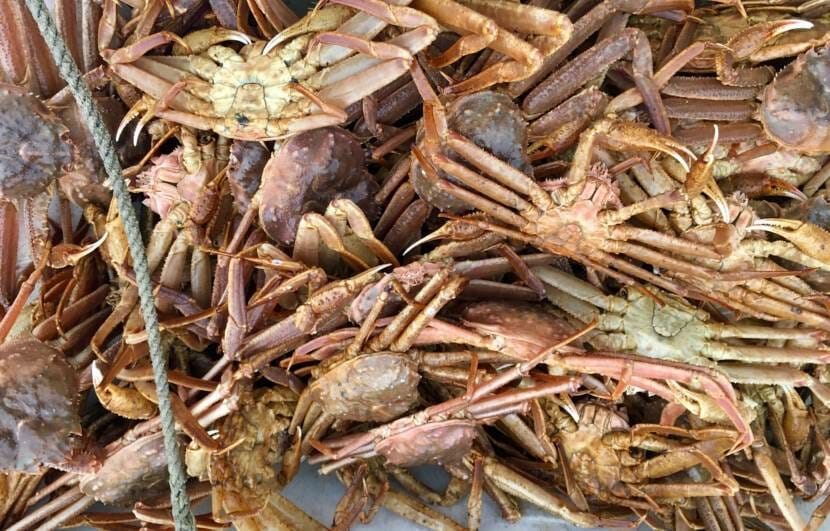
The tanner crab fishery begins on Sunday in Southeast Alaska. But crabbers are facing low prices, and bitter crab disease is expected to reduce the sellable catch.
Typically 60-80 boats participate throughout Southeast.
This year the prices are expected to be low compared to recent years. An Anchorage Daily News article lists the end of pandemic stimulus money as a possible factor in reducing consumer demand. But there’s a geopolitical component to this story, according to Haines tender Brent Crowe.
“The biggest thing that’s happening right now is that the collapse of the snow crab fishery in the Bering sea has disrupted the supply chain,” he said. “Markets that are used to having crab available are looking elsewhere. And the Japanese market has started sourcing crab from Russia, through China to circumvent the embargo on Russian seafood.”
The embargo was put in place after Russia invaded Ukraine. Crowe says because Russians seafood processors have difficulty finding buyers, they are cutting their prices. Crowe says the availability of that cheap Russian seafood has impacted the tanner crab market.
“Last year the price was $8,” he said. “Right now it’s looking to settling in the $3 range, the initial offering was $2.50.”
The price drop led to a two-week strike in Kodiak. Crowe says there is no indication a similar action will take place in Southeast.
“Southeast fishermen generally don’t organize like that,” he said. “They either just participate or they don’t based on whether they see it as profitable. Central gulf fishermen seem to be more organized in that kind of a way.”
Some crabbers could see their income further reduced by bitter crab disease. The disease causes the flesh to taste like aspirin. There are some visual cues to the condition, and processors don’t buy those crabs.
The amount of affected crab varies with location, but in the Lynn Canal it can be as high as 80%. That means crabbers get money for only one in every five crab they catch.
The sick crabs are cooked to kill the disease, and brought to the landfill to avoid its spread. Crabs have been known to catch the disease after feeding on dead infected crabs. The disease is caused by a single-celled plankton that uses the crab as part of its reproductive cycle.
Adam Messmer is a shellfish biologist with the Alaska Department of Fish and Game.
“It gets into the crab’s blood and starts replicating within the crab,” Messmer said. “It slows the crab down, and you see that in fish tickets too, that the first couple of landings that a fisherman will have will have fairly low amount of bitter crab. And then as the season progresses, the percent of bitter crab goes up. And the thought is that those crabs are slower since they are sick, to crawl into the pot.”
Messmer has studied some sick crabs in his lab. The single cell organisms that cause bitter crab are called dinoflagellates. Messmer says they use the crab as a host before releasing their spores.
“We’ve seen them sporulate in the lab, and the crab will kind of sit up on its legs, and start shaking and this red cloud comes out of its mouth, almost out of a science fiction movie. And those are the spores of the young dinoflagellate that are sent out into the water column,” he said. “And, at least the one in the lab, as soon as it was done doing that, it died instantly.”
Bitter crab is not harmful to humans. The only effect is a bad taste in the mouth. Messmer says scientists have not been able to determine what causes bitter crab numbers to rise and fall.
“I think it’s just something we are going to have to live with in this area. For a long time it’s stayed really steady,” he said.
On Sunday at noon, the Department of Fish and Game will announce the duration of the opener. Crabbers can expect a minimum of five days in the most productive and best studied areas, with another five days to fish the less desirable areas.