
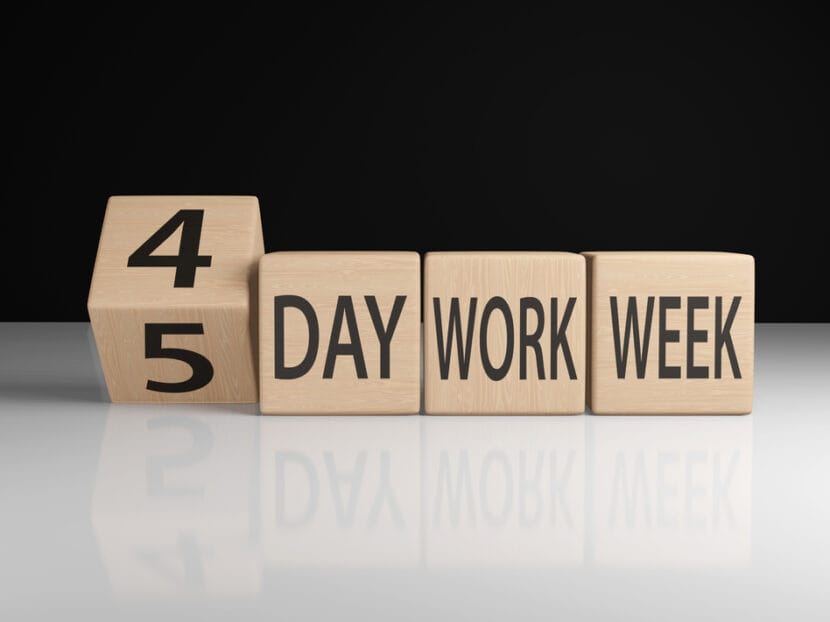
The four-day workweek is proving to be the gift that keeps on giving.
Companies that have tried it are reporting happier workers, lower turnover and greater efficiency. Now, there’s evidence that those effects are long lasting.
The latest data come from a trial in the U.K. In 2022, 61 companies moved their employees to a four-day workweek with no reduction in pay.
They began it as a six-month experiment. But today, 54 of the companies still have the policy. Just over half have declared it permanent, according to researchers with the think tank Autonomy, who organized the trial along with the groups 4-Day Week Campaign and 4 Day Week Global.
Follow-up surveys help to explain the four-day workweek’s success.
Improvements in physical and mental health, work-life balance, and general life satisfaction, as well as reductions in burnout, have been maintained over the past year, says sociologist Juliet Schor of Boston College, who’s part of the research team. Workers report higher job satisfaction now than before the trial began.
“The results are really stable. It’s not a novelty effect,” she says. “People are feeling really on top of their work with this new model.”
Similarly positive results are emerging from other four-day workweek trials, including in the U.S., Schor says.
“Doesn’t happen by magic”
At a recent webinar, participating companies shared their experiences and tips for success.
“It absolutely doesn’t happen by magic,” says Nicci Russell, CEO of the London-based water conservancy non-profit Waterwise. “You can’t just drop a day and carry on as usual, because how stressful would that be?”
Russell says after some initial teething problems, they managed to find efficiencies that allow all 10 employees to take Fridays off. They keep all meetings to 30 minutes and make sure those meetings start on time. They block off focus time on their calendars — sometimes even declaring Monk Mode Mondays. They’re more mindful of the emails they send and of the time they spend going through their inboxes.
“I only do my emails now at certain times of the day. I’m not drawn into them all day, every day,” she says.
At the end of the pilot, the staff at Waterwise were unanimous in their desire to continue the four-day week. A majority said they wouldn’t consider a five-day-a-week job again unless presented with a significant pay raise.
“It’s brilliant for retention, which is super important in a teeny organization like ours,” says Russell.
No one-size-fits-all
One important finding, researchers say, is that there is no one-size-fits-all recipe when it comes to the four-day workweek.
At Merthyr Valleys Homes in South Wales, giving everyone Fridays off wouldn’t have worked, says Ruth Llewellyn, who led the pilot at the housing cooperative.
With 240 employees working in roles from customer service to home repairs and maintenance, they decided to keep their operations running from Monday through Friday.
“For us, the thought of dropping repair service for our tenants one day a week meant that we wouldn’t be providing the same service,” Llewellyn says.
Instead, employees work a variety of schedules depending on individual and team needs. Some have a set day off every week, while others are on a rolling schedule. Some employees work two half-days, and some still work five days a week but shorter hours, allowing them to drop off and pick up their children from school.
The teams found time savings in different places. Some of the trades staff found they could reduce travel time to and from the building supplier with better planning around which materials they needed. Customer-facing teams found they could address smaller issues quickly over the phone.
Employees are more motivated, employee performance has held consistent, and absences for illnesses have fallen, Llewellyn says.
Yet the company is not committing to the four-day workweek forever — at least, not yet. Hoping for still more data, it extended the pilot and will re-evaluate the results later this spring.
“We’re really hopeful at that point that we can make it permanent,” says Llewellyn.
Why companies fail
Of the 61 U.K. companies that joined the 2022 pilot, only a few have discontinued the four-day workweek.
At one small consultancy, although the staff reported improved morale and the company reported a boost in efficiency, there were problems managing client and stakeholder expectations, according to feedback collected after the pilot.
Researchers suggest that better external communications and more flexibility in adapting the policy to challenging conditions might have made a difference.
“There is a suggestion that the organisation did not give the policy enough of a chance, and indications of a change of heart on the issue from management,” the researchers wrote.
9(MDEwMjQ0ODM1MDEzNDk4MTEzNjU3NTRhYg004))
Transcript :
AILSA CHANG, HOST:
The four-day workweek for five days of pay is proving to be the gift that keeps on giving. Companies who are trying it report happier workers, lower turnover and greater efficiency. NPR’s Andrea Hsu reports on the latest research coming out of those trials.
ANDREA HSU, BYLINE: Around this time last year, early results from a large trial in the U.K. caused a hullabaloo. Of 61 companies that had moved to a four-day workweek with no reduction in pay, 92% said they would continue with it. Now another whole year has passed, and all but a few have either made it permanent or extended their trials. Boston College sociologist Juliet Schor is part of the research team.
JULIET SCHOR: People are feeling really on top of their work with this new model.
HSU: She says the gains are not a novelty effect, and they’re not limited to the U.K. Survey data from elsewhere, including here in the U.S., show lasting improvements in things like physical and mental health and work-life balance.
SCHOR: The results are really stable.
HSU: A couple of the U.K. employers talked about their experiences in a webinar hosted by the researchers. Nicci Russell, who leads a water conservation nonprofit in London, says she realized early on…
NICCI RUSSELL: You know, if we close on a Friday, nobody dies. We aren’t doctors. We’re not running a chip shop.
HSU: Still, they were busy, so to make it work, they now keep all their meetings to half an hour. They block off focus time in their calendars. They’re more mindful about email.
RUSSELL: So I only do my emails now at certain times of the day. I’m not sort of drawn into them all day every day.
HSU: All 10 people at the company loved the changes. Most of them said they wouldn’t consider a five-day-a-week job again without a significant raise.
RUSSELL: It’s brilliant for retention, which is super-important in a teeny organization like ours.
HSU: Now, one thing the researchers have learned is that there’s no one size fits all. Giving everyone Fridays off wouldn’t have worked for the housing cooperative in South Wales where Ruth Llewellyn works. They have 240 employees working in roles from customer service to home repairs and maintenance.
RUTH LLEWELLYN: We still operate a Monday to Friday service because, for us, the thought of dropping a repair service for our tenants one day a week meant that we wouldn’t be providing the same service.
HSU: So employees work a variety of schedules. Some have a set day off, and for others, it changes.
LLEWELLYN: We’ve also got people that do two half-days, people that do five days shorter hours, which allows them to do things like drop the children at school and pick them up.
HSU: Llewellyn says there are fewer sick day call-outs, and employee performance has been consistent. Still, they want to collect more data, so they extended their pilot for another year.
LLEWELLYN: We’re really hopeful at that point that we can make it permanent.
HSU: Now, the researchers did talk about one of the very few companies where the experiment failed. A small consultancy struggled with managing client and stakeholder expectations. Although employees were happier, management had a change of heart. The researchers suggest that better planning and more flexibility might have changed that outcome. Andrea Hsu, NPR News.
(SOUNDBITE OF SWEET CHARLES SONG, “YES IT’S YOU”) Transcript provided by NPR, Copyright NPR.