
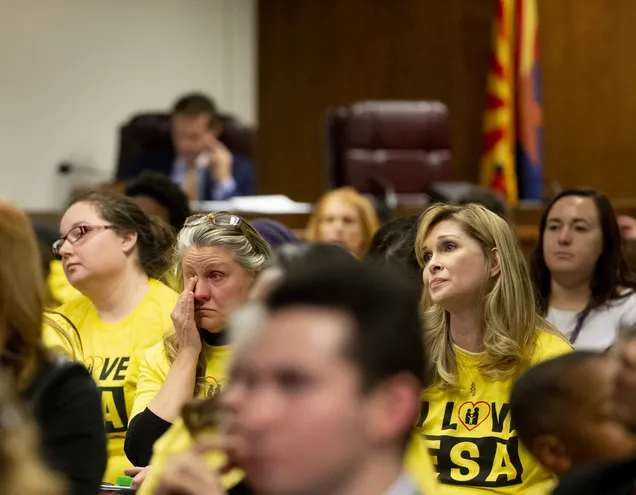
Arizona Senate passes School Voucher Expansion: This school year, the voucher program will be worth more than $300 million: The Arizona Senate approved Monday a massive expansion of Arizona’s school voucher programs, only two years after voters repealed similar voucher expansions for all students.
Arizona Senate passes huge school voucher expansion, 2 years after voters said no https://t.co/wHiBgF3YNl
— azcentral (@azcentral) February 16, 2021
The Senate approved the bill with 16-14 votes from the party lines. All 16 Republicans voted for it. The invoice will now be sent to the House of Representatives.
Parents can take money from public schools to pay for private schools through Empowerment Scholarship accounts. The bill would allow for the program’s expansion, which currently serves 9,700 students, and makes it accessible to a much larger number.
The bill sponsors claim that the voucher expansion will only benefit low-income students attending Title I schools. These schools receive funding to help students with disadvantaged backgrounds close their educational gaps.
SB 1452 would allow students who live within the boundaries of Title I schools to apply for an empowerment scholarship account. To be eligible, students would only need to attend school. They would not have to be of low income.
Arizona’s 2,000 school districts are home to more than 1,300 Title I schools. This is about 65%. Wealthy districts may also include Title I schools.
According to the Arizona Department of Education, the bill would allow two-thirds of Arizona’s public school students, 650,000 to 700,000. These children, or 1.1 million, are eligible for vouchers to private schools.
Arizonans considered a ballot initiative to block legislation that would have permitted all 1.1 million public school students in Arizona to apply for ESAs. Voters rejected universal vouchers by a margin of 65% to 35%.
The bill this year is more than the expansion that voters voted down. The previous expansion measure contained a cap on enrollment that limited the number students who could be admitted to school to the tens or thousands, at least for a time.
The SB1452 also expands the pool of students eligible. It eliminates the requirement for students to spend 100 days in public schools during the previous school year.
Students would be required to attend public school for 30 days during the current school year, and then they could transfer to private school immediately. Open enrollment allows students to go to Title I schools and then transfer to private school within 30 days. This would make almost every student eligible for an ESA.
ESAs are currently restricted to students in six categories: foster children, students with special needs, students on Indian Reservations, and students who attend D or F schools.
Students who are eligible receive 90% of the funding that would otherwise have gone to their school districts. These public dollars can be loaded onto debit cards and used to pay for private school, tutoring, therapy, or other services.
e Opponents estimate that this expansion could increase the state’s annual cost by more than $300 million.
Phoenix Republican Sen. Paul Boyer who co-authored the bill said that the bill was primarily focused on helping students stuck in failing schools. Students who are in failing schools can still benefit from the ESA program.
Many people don’t use the program because it doesn’t cover the cost of private school education. e
Democrats criticized the program harshly as an attempt at defunding public education. This was a affront to voters who just rejected the voucher program, and an attempt re-segregate school.
Lela Alston (D-Phoenix) called the measure a down payment for families that are better off to attend private schools because individuals with low income can’t afford the difference in what private schools charge.
Rebecca Rios (D-Phoenix) called the measure a calculated move to resegregate schools under the “guise helping poor children and people with color.”
Rios stated, “If we truly wanted to help the poor children, there would be an income limit.”
Because there are very few private schools in rural Arizona, she said that the bill was a huge transfer of resources from rural Arizona into urban Arizona. She said that rural Arizonans will pay for their children to attend private schools in Phoenix and Scottsdale, Paradise Valley, Tucson, and Paradise Valley.
Boyer stated that he was fighting for students from low-income and high poverty who are trapped in failing schools. He stated, “That’s what I’m fighting to defend.”
Boyer stated, “To claim that this bill somehow encourages segregation” Boyer said, “A family can choose the school that is best for their child.” This is freedom, not segregation. Fundamentally, the problem of segregation that we are facing today is assigning families to schools in inferior neighborhoods based on their home addresses.
Dawn Penich-Thacker spokeswoman for Save Our Schools Arizona. She stated that the organization would do everything necessary to repeal the law. This includes a citizen initiative or legal action.
Penich-Thacker stated that “despite Arizona voters repeatedly voting against private school voucher expansion and funding public schools, out of-state lobbyists & anti-public education politicians once again showed they have no regard to the will of voters & taxpayers.” “SOSAZ reiterates its commitment to taking all necessary steps to stop the attack on our public school, regardless of whether it is through citizen’s initiative or referral to the 2022 election ballot.
SB 1452 will allow more students to apply. It would also make significant changes to the funding of ESA and public schools. These are some of most important education funding changes in recent years. SB 1452 would:
- Use funds from Prop. Prop. 301 — which is earmarked for teacher salary increases, class size reductions and dropout prevention programs — can be used to send money to students going to private schools. Parents of kindergarteners can also use the classroom site money to pay for private school.
- ESA students can also pay for commercial or public transportation to private schools. Parents were previously unable to use their accounts for transportation.
- Parents can use ESAs to help pay for education costs not covered by their health insurance.
- Prior to this, voucher holders were not allowed to also receive funds from School Tuition Organizations. These organizations get tax credits-funded donations and then donate the funds to private schools. Students in high school can double dip and receive funding from both sources, up to the amount spent in their school district.
- Parents should not lose money that they have misplaced on items that aren’t allowed. This is unless the Arizona Attorney General finds fraud. Misspent money can be forfeited, rather than being returned.
The Senate Rules committee ruled that it was necessary to have a 2/3 vote in order to pass a portion of the bill that would have made school districts that don’t receive state funding pay for the costs of students who leave their schools and go to private schools.