
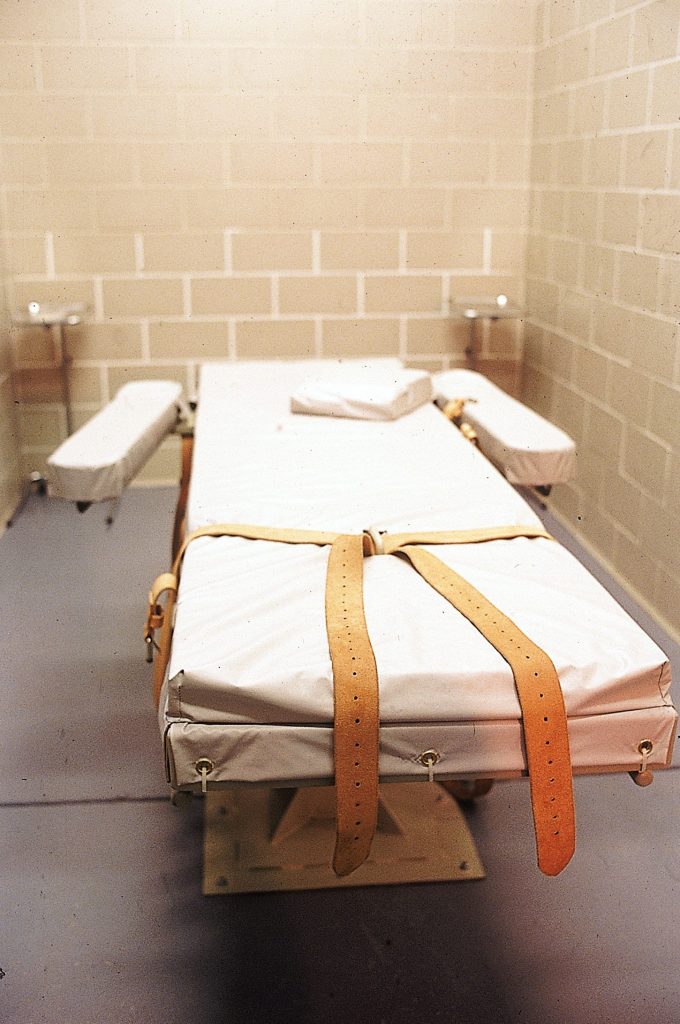
Recent inability of states to introduce intravenous lines in executions have led to increased scrutiny on the most commonly utilized death penalty within the United States. Issues in Arizona and other states this week revealed flaws in the method that critics of lethal injection refer to as the “veneer to medicalization.”
In Arizona where the state reinstated the death penalty in January after a hiatus of eight years Corrections officers have been unable to establish IV lines for the three injections. They have had to resort to placing a catheter into the femoral veins of the condemned man at two occasions.
The attorneys for Clarence Dixon, who was executed on May 11th, said it took 40 minutes to inject IVs inside the body of. Dixon’s execution team was forced to injecting an IV line into the femoral vein of his body that resulted in him experiencing discomfort, and led to the loss of a “fair volume of blood” According to witnesses in the media.
The execution team involved in the execution on June 8 of Frank Atwood also struggled to insert IVs, prompting the technicians to look at the femoral vein as well. Then, Atwood asked the team to test his hands again, eventually guiding them to make the successful insertion through one of the hands of his.
Last Wednesday, Murray Hooper turned and asked the audience, “Can you believe this?” as the execution team unsuccessfully to place IVs into his arms prior to inserting the catheter into the vein in his femoral.
The latest execution: Who Is Murray Hooper? What do you know about Arizona’s upcoming execution
Texas the next day the prison spokeswoman stated that an execution by Stephen Barbee was prolonged because Barbee cannot physically straighten his arms. This is something his lawyers had warned him in the courtroom. Prison officials eventually inserted IVs into Barbee’s hand and around his neck as reported by The Texas Tribune.
The following day , in Alabama corrections officials were unable to do so for the second time to put IV lines into the prisoner who was in a solitary confinement and resulted in the death of Kenneth Eugene Smith being postponed. In the Montgomery Advertiser reported the execution team attempted to find a vein in Smith at least “about one hour” before stopping.
Alabama stopped the executions of Alan Eugene Miller for the same reason two months prior. This past Monday Alabama governor halted Kay Ivey and stopped all executions across the state and demanded an “top-to-bottom” examination of the procedure.
Arizona Department of Corrections execution protocols
It states that the members of the team for execution “shall be licensed or certified within the United States to place IV lines.”
Furthermore, “A femoral central line should only be used when the person who inserts the line is qualified by training, experience or certification within the United States to insert a central line for femoral insertion.”
Medical experts have said that no certification or license is available.
The American Medical Association’s Code of Medical Ethics stipulates that physicians should not be involved in executions. This means that corrections departments frequently depend on training staff members to join execution teams.
Retired corrections officer Jim Klein, who participated in 15 executions using lethal injections, told The Republic that he and the other members of the execution team in the 1990s had zero prior experience administering IVs. Klein claimed that a medical professional advised them to try their hand with a prosthetic arm prior to then attempting the same on each other.
“Well-trained medical professionals generally aren’t interested in being involved in executions since they’ve sworn to protect themselves from damage,” said Ngozi Ndulue as vice director at the Death Penalty Information Center. “So we shouldn’t be shocked that people who haven’t received proper training can’t effectively complete these IV insertions without resorting to excessive measures.”
People who have a job in medicine claim that the continuing failures of corrections agencies indicate they’ve not had the ability to find members of the execution team with extensive knowledge. Medical experts have told The Republic it can take up to a month teach someone how to perform the proper insertion of an IV.
As per Arizona Department of Corrections protocols Members of the IV team are required to complete one training session prior to execution.
“It appears that these people don’t have a clue since they’re poked around everywhere in search of a vein” the Dr. Nathan Laufer, medical director at the Heart & Vascular Center of Arizona. “Anybody who has any type of medical education should be able start an intravenous line inside an arm.”
A study conducted by Frank Atwood’s lawyers of the 14 lethal injections that had been administered in Arizona prior to the Clarence Dixon’s injections revealed the IV insertion times varied from 7 minutes to 54 minutes, and a the median being 23 minutes.Laufer noted that the repeated usage of the central line of the femoral artery is yet another red flag.
“It ought not to be that far off,” he said. “I consider it to be an act of desperateness.”
It was reported that the Arizona Department of Corrections Friday did not answer questions regarding the process of execution, or the recent issues in the insertion of IVs, claiming the information was covered under the law of the state. It was reported that the Arizona Attorney General’s Office and Maricopa County Attorney’s Office did not respond to requests for information.
The attorney Joseph Perkovich watched in disbelief as his client Frank Atwood, guided his executioners through the procedure of inserting IVs in the Florence state prison in Arizona in June.
The secrecy that covers the credentials of executioners hinders the ability to determine their ability to perform the job.
“The notion that the participants should be protected to ensure their safety has no base,” Perkovich said. “It is fabricated to not be accountable. The shame and savagery of Arizona’s its victims exposes the pretext of respectability by using medical equipment to commit murder.”
Texas and Alabama are not able to permit witnesses to see the IV insertion part of executions.
However, Arizona was forced to permit witnesses to witness the entire execution process at the point that the prisoner is admitted into the chamber for execution, following the federal court judge ruled against The Arizona Republic and other media outlets that sought access to the execution in 2016.
Attorney for constitutional law and media David Bodney said witnessing the entire process of executions is crucial.
“The public has the right to scrutinize these actions as well as to examine them to witness them and make sure that the procedures are in accordance with the public’s wishes,” Bodney said.
The Death Penalty Information Center, which Ndulue serves as the deputy director of The Death Penalty Information Center is an Washington, D.C.-based nonprofit that publishes research on executions for death. Ndulue said that the secrecy surrounding executions by lethal injection and the people who execute executions increases the risk of more procedural issues.
“A review of the protocols and employee training is the next step to take,” she said. “But the organizations who are in charge of this information aren’t prepared to acknowledge that there are issues that are occurring. Secretive layers as well as denial actually limit the options for remedy.”
History of the death row: The things you must be aware of concerning Arizona’s death rows and its past of executions and its the failures
“The appearance of medicalization isn’t holding the test of time,” the Ndulue administration said. “Lethal injections aren’t a medical procedure, it’s the execution.”
Cassandra Stubbs, project director of the Capital Punishment Project at the ACLU she said that even though states’ recent efforts to execute executions constitute cruel and unusual punishment but there are more issues with lethal injections than not being able to access veins.
“We’ve witnessed attempts to test various methods, drugs and protocols in the past as well as continuing to witness major issues in executions that go wrong,” she said. “States continue to execute executions that can be gruesome and unconform to the Eighth Amendment’s ban on punishments that have a high risk of suffering severe suffering.
Stubbs declared that The Eighth Amendment prohibits cruel and inhumane punishments which pose the possibility of “superadded terror, pain or shame.”
“The method used to cause prisoners to writhe in extreme pain, and often tied to gurneys for hours is terrifying and crosses the boundaries of human decency,” she said.
Perhaps more concerning, Stubss says we have entered a new chapter in the death penalty in which condemned individuals who are granted stays of execution are transferred to the death chamber following a shadow docket decision by the Supreme Court. A shadow docket typically utilized for procedural cases that are not subject to an exhaustive briefing or hearing.
“So the majority of these executed executions that went wrong were from an appeals court in the federal courts of appeals judge had upheld the stay and stated “You know is the real issues in this case.'” Stubbs said. “Because lawyers were declaring, ‘Look, they’re not going to locate a vein’ there’s a lot of problems. There ought to be an investigation in this case. There ought to be some sort of discovery. There ought to be a court procedure.'”
“The federal courts declare”Yes, we’ll need to examine this, and we’re going stop execution. Then it’s the Supreme Court just wipes it out any explanation, but they don’t mention the reason,” Stubbs said. “So If you believe that the Supreme Court can’t be counted to protect the Constitution then we’ll be forced to seek out the states, and we’re going have to go to the corrections department.”
Multiple states under scrutiny for recent lethal injection failures: "It sounds like these folks don’t know what they’re doing if they're having to poke around all over the place to find a vein" via @USATODAY https://t.co/ySCSZOjRUr
— Jimmy Jenkins (@JimmyJenkins) November 23, 2022